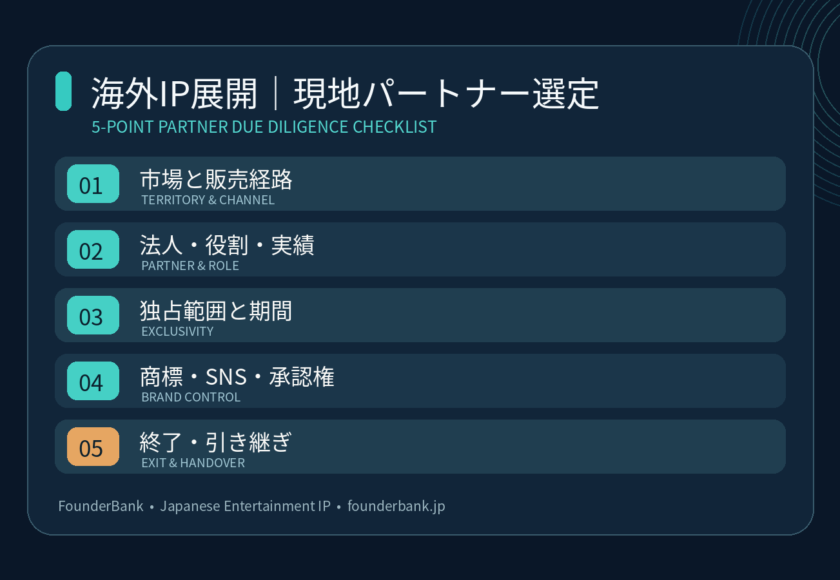
日本のアニメ・ゲームなどのIPを海外で展開するとき、最初に決めることの一つが「現地でだれと組むか」です。販売や配信を任せるパートナーを急いで決めると、地域の範囲、独占の条件、ブランドの管理があいまいなまま関係が始まり、後から調整しにくくなります。この記事では、海外の法人にも日本の法人にも使えるよう、現地パートナーを決める前に整理しておきたい5つの確認点をまとめます。
参考にした資料の多くは、物品販売の海外ディストリビューター契約や、アニメの配信権ライセンスを扱った一般的な解説です。アニメ・ゲーム・声優領域に固有の慣行や相場を示すものではありません。本記事は法的助言ではなく、個別の契約は各国の法令に詳しい専門家への確認が必要です。
1. 対象とする市場と販売・配信の経路を先に具体化する
Harris Sliwoski法律事務所の解説は、流通チャネルと地域を具体的に把握し、契約上の地域定義もその戦略に合わせるべきだとしています。複数の国をひとつの市場として扱うことは、高くつく誤りになりうるとも述べています。アニメの配信権の分野でも、権利は国・地域単位で扱われ、同じ作品でも地域ごとに異なる相手が権利を持ちうると説明されています。
- 対象にする国・地域を、広い呼び方ではなく国名で書き出す。同じ解説は、ある地域名が何を含むかの曖昧さが紛争の原因になると指摘しています。
- 自社サイト、配信プラットフォーム、小売、イベント会場など、どの経路で届けるかを分けて整理する。
- 現地語での表示や告知をだれが担うかを決めておく(これは出典に基づかない一般的な整理です)。
2. 相手の役割と素性を確認する
同じ解説は、自己の計算で仕入れて転売するディストリビューターと、手数料で販売を仲介するエージェントとでは、税務、解除権、責任、現地の強行法規上の扱いが異なり、契約上の名称だけでは判断できないとしています。あわせて、所有構造、取引先への支払状況、財務力、訴訟歴、競合品の取り扱い、署名権限、販売の適法性を事前に確認すべきだとし、先方から売り込んできた相手ほど慎重に評価するよう述べています。
IPの展開では、相手が物品を仕入れて売る立場なのか、配信や許諾を受ける立場なのかによって確認する項目が変わります。どの立場で何を任せるのかを、最初に文章で整理しておくと話が早くなります(一般的な整理です)。
3. 独占権は実績に応じて段階的に与える
解説では、独占権は初めから与えるものではなく、実績で得るものという考え方が示されています。非独占や期間限定から始め、販売・報告・支払いの実績を見てから範囲を広げ、目標に届かない場合は独占の喪失、地域や範囲の縮小、解除などの措置を契約に明記するよう勧めています。具体的な数値目標の水準は記事に書かれておらず、案件ごとに協議する事項です。
配信権の解説では、競合が排他権を持っている間は、需要があっても同じ作品を取得できない「ホールドバック」が生じると説明されています。排他的な権利を渡すということは、自社が他の相手に渡せなくなる期間が生まれるということでもあります。
4. ブランドとアカウントの名義・承認権を決める
同じ解説は、代理店に商標などを使わせる前に主要な商標を出願すること、代理店が商標、ドメイン、SNSアカウント、販売プラットフォームのアカウントを自己名義で登録することを禁止することを挙げています。現地向けの翻訳サイトや商品写真、オンライン出品についても、所有権と承認権を確保すべきだとしています。
- 作品名やキャラクターの使い方、告知文を最終承認するのはだれか。
- 現地で開設するSNSや販売ページの名義と管理権は、どちらが持つか。
- 配信では、地域外からの視聴を防ぐ措置(ジオブロッキング)が契約上の遵守義務になりうると解説されています。
5. 終了するときと、もめたときの取り扱いを先に決める
解説は、重大な違反による解除、更新しない場合、支配権の変更を別々に定めるよう勧めています。重大な違反による即時解除は、是正の期間(記事では30日から60日という例)がなければ実効性が低いとも指摘しています。終了時の在庫、商標の使用、オンライン出品の扱いも決めておくべきだとしています。
紛争解決については、仲裁や管轄の条項は相手の資産がある地域で判断を執行できなければ意味がなく、準拠法と仲裁地は別の問題だとしています。Carlton Fieldsの解説は、国によっては関係を終えるときに補償に類する支払いが必要になるおそれがあること、世界共通の契約書を使い回さず現地の弁護士に限定的なレビューを依頼することを勧めています。
実務チェックリスト
- 対象国・地域と販売・配信チャネルを列挙したか
- 現地企業の法人名・権限・役割を確認したか
- 独占の範囲・期間・評価基準を整理したか
- 商標・SNS・素材の名義と承認権を確認したか
- 契約終了時の引き継ぎと相談先を整理したか
FounderBank に相談する場合
FounderBank のサイトでは、海外進出ルートと拡散サポートとして、現地パートナー、配信・販売ネットワーク、SNS・PR施策までを含めて「売れるための仕組み」ごと設計する事業を掲げています。本記事の確認点は一般的な整理であり、契約書の作成や法的判断、特定のパートナーの紹介や成果を約束するものではありません。ご相談の際は、対象にしたい国・地域、扱うIP、希望時期、予算の目安、決定権者が分かっていると整理しやすくなります。
Before You Choose a Local Partner Overseas: 5 Points for Companies Taking Japanese IP Abroad
Choosing who to work with locally is one of the first decisions when taking Japanese anime, game or other entertainment IP overseas. If a sales or distribution partner is chosen in a hurry, the territory, exclusivity and brand control can stay vague and become hard to adjust later. This article summarizes five points to organize before you decide, for both overseas and Japanese companies.
Most of the materials referenced are general explanations of international distributor agreements for goods, and of anime streaming rights licensing. They do not describe customs or market rates specific to anime, games or voice acting. This article is not legal advice; individual contracts should be reviewed by professionals familiar with the relevant countries' laws.
1. Define target markets and sales or streaming channels first
Harris Sliwoski’s commentary says channels and territories should be understood concretely, and that the contract's territory definition should follow that strategy. It also warns that treating several countries as one market can be a costly mistake. In anime licensing, rights are likewise handled by country or region, so different licensees can hold the same title in different territories.
- Write down target countries by name rather than broad labels; the same commentary notes that ambiguity about what a regional name includes is a common source of disputes.
- Separate the routes: your own site, streaming platforms, retail, event venues and so on.
- Decide who handles local-language display and announcements (a general organizing point, not drawn from the sources).
2. Confirm the partner's role and background
The commentary explains that a distributor, who buys and resells on its own account, and an agent, who mediates sales for a commission, are treated differently for tax, termination rights, liability and local mandatory law, so the label in the contract alone is not enough. It recommends checking ownership structure, payment record with other suppliers, financial strength, litigation history, handling of competing products, signing authority and the legality of sales in advance, and being especially careful with a party that approached you first.
For IP, the items to check change depending on whether the partner buys and resells goods, or receives a license or streaming rights. Writing down what role you are entrusting to the partner makes discussions faster (a general organizing point).
3. Grant exclusivity in stages, based on results
The commentary frames exclusivity as something earned through performance. It suggests starting non-exclusive or time-limited, widening the scope after seeing sales, reporting and payment results, and writing into the contract the consequences of missing targets, such as losing exclusivity, narrowing territory or scope, or termination. The article gives no specific target figures; those are matters to negotiate case by case.
A streaming-rights explainer notes that while a competitor holds exclusive rights, a title cannot be acquired even if demand exists, a situation called a holdback. Granting exclusivity also means a period in which you cannot offer the title to others.
4. Decide who owns and approves brand assets and accounts
The commentary lists filing key trademarks before letting a distributor use them, and prohibiting the distributor from registering trademarks, domains, social accounts or marketplace accounts in its own name. It also says ownership and approval rights should be secured over local translated sites, product photos and online listings.
- Who gives final approval on how titles and characters are used, and on announcement text?
- Who holds the name and control of locally created social accounts and sales pages?
- For streaming, the explainer notes that geo-blocking can be a contractual compliance obligation.
5. Decide how the relationship ends and how disputes are handled
The commentary recommends defining termination for material breach, non-renewal and change of control separately. It adds that immediate termination for material breach is often ineffective without a cure period (the article mentions 30 to 60 days as an example), and that stock, trademark use and online listings at termination should be settled in advance.
On dispute resolution, it says arbitration or jurisdiction clauses mean little if a ruling cannot be enforced where the partner's assets are, and that governing law and the seat of arbitration are separate questions. Carlton Fields’ commentary warns that in some countries ending a relationship may require a payment resembling compensation, and recommends not reusing a single global contract but having local counsel conduct a limited review.
Practical checklist
- List target countries and distribution channels
- Confirm the partner’s legal identity, authority and role
- Define the scope, term and review criteria for exclusivity
- Agree on ownership and approvals for trademarks, accounts and assets
- Plan termination, handover and dispute escalation
If you consult FounderBank
FounderBank's website describes a business line covering overseas expansion routes and promotion support, designing the whole mechanism for selling, including local partners, distribution and sales networks, and social media and PR. The points above are general organization and do not promise contract drafting, legal judgment, introduction of any specific partner, or any particular result. It helps if you can share the target countries, the IP involved, the desired timing, a rough budget and the decision maker.
お問い合わせ / Contact
海外展開の進め方や現地パートナーの検討についてのご相談は、お問い合わせページからご連絡ください。
To discuss overseas expansion or the search for a local partner, please contact us through the contact page. English inquiries are also accepted.
参考資料 / References
- Harris Sliwoski, China Law Blog: International Distribution Agreements (2026-07-08)
- Carlton Fields: Rules of the (International) Road: Choosing and Appointing a Distributor
- Vitrina: Anime Regional Rights: How Windowing and Territory Restrictions Affect Value
- FounderBank 事業内容 / Services
- FounderBank お問い合わせ / Contact





この記事へのコメントはありません。