Fictional design scene: a player enters a deserted station in a Japanese-language version of an atmospheric adventure game. There is no dialogue. Footsteps, a distant announcement and the player’s own curiosity create the tension. Should the studio cast a Japanese protagonist and record every possible reaction—or would a handful of carefully placed vocal cues work better?
For an overseas game studio founder, game director or audio producer, this is a game-design decision before it is a casting decision. “We want Japanese voice actors” does not yet specify what should be recorded, what the player will experience, or which rights and delivery conditions need agreement. This guide offers a four-scene test, a scope matrix and a copy-ready feasibility brief. All scenes are illustrative design exercises, not client case studies or measured outcomes.
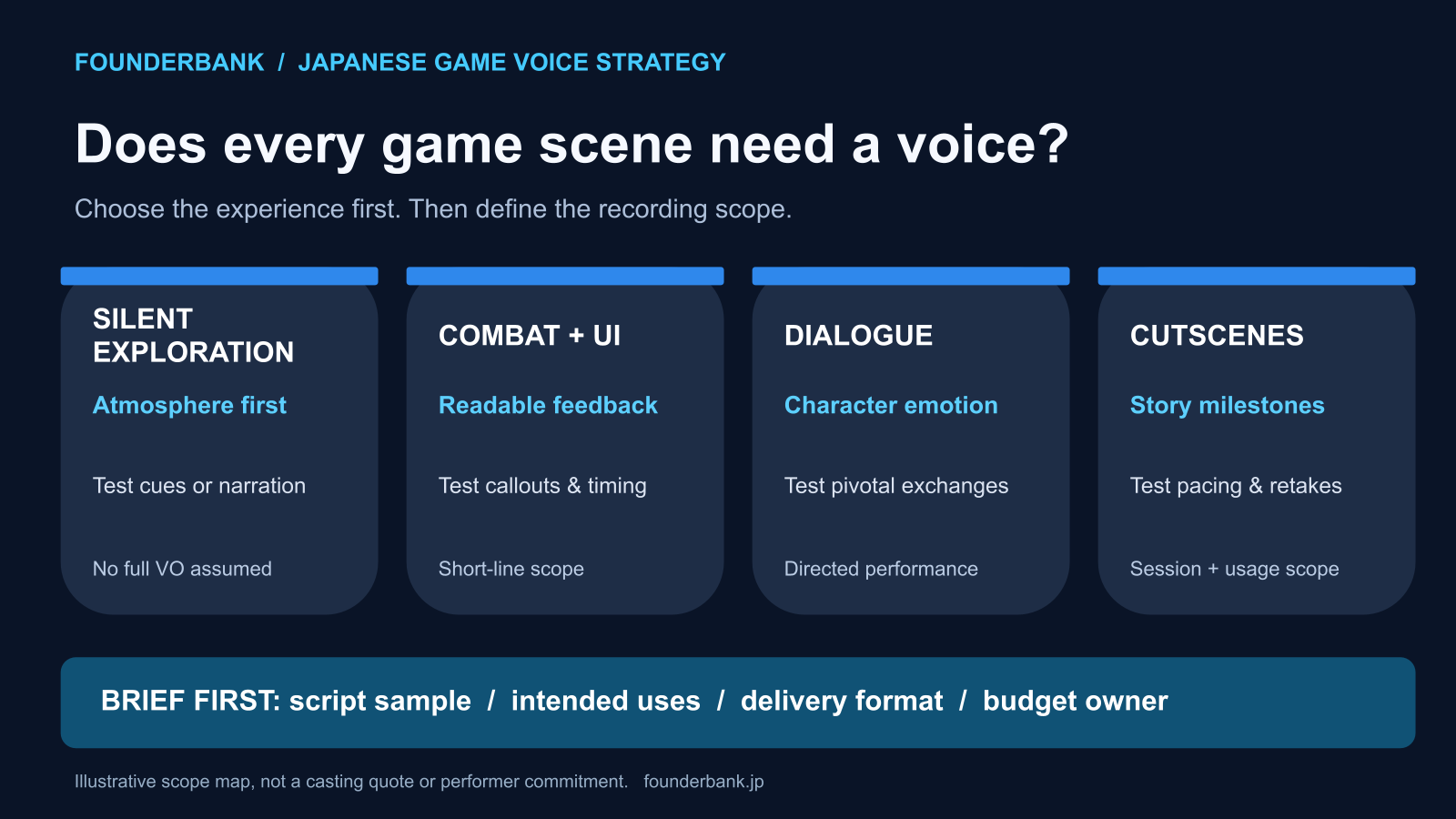
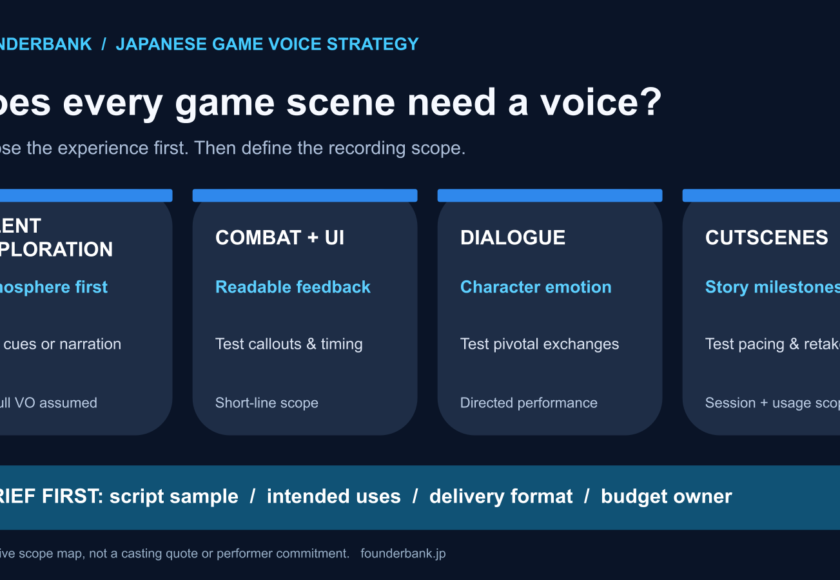
The four-scene test: where would a Japanese performance change the experience?
| Playable scene | Question to test | Possible first recording scope | Decision owner |
|---|---|---|---|
| Silent exploration | Would speech deepen the world—or interrupt the atmosphere and player interpretation? | Optional narrator cue, environmental voice, or no spoken protagonist at all | Game and narrative directors |
| Combat and interface | Can a short Japanese callout communicate an action without obscuring gameplay feedback? | Representative battle cues, warnings and short UI lines | Combat designer, audio director and localization lead |
| Interactive dialogue | Do alternate choices preserve character intent and sound natural in Japanese? | One branching exchange with distinct emotional directions | Narrative director and Japanese language director |
| Cutscene | Does the performance fit the scene’s rhythm, animation and target platform? | A short directed scene with agreed retake and synchronization criteria | Cinematic director, producer and audio team |
These are not four mandatory production phases. A game may need one, several, or none. The point is to identify the player-facing job of the voice before choosing a performer or asking for a full-series quote.
One fictional game, three different decisions
Imagine an original mystery game whose protagonist rarely speaks. Its studio has a playable exploration prototype and a limited audio-production budget. Three plausible choices are:
- Keep the protagonist silent: concentrate Japanese audio work on environmental announcements and a supporting character’s pivotal line. The creative question is whether this preserves the intended uncertainty.
- Voice gameplay information selectively: record short warnings and interaction cues. The usability question is whether players understand actions more quickly without the voice becoming repetitive.
- Voice only story milestones: use a directed performance for a few emotionally important scenes. The narrative question is whether a spoken performance strengthens character relationships.
The studio should compare these options in a playable build rather than assume that more lines automatically create a better localized experience. This is a hypothetical production choice, not a claim that one option always costs less or converts more players.
Before casting, make six decisions that change the quote
| Scope item | What the studio should specify | Who needs to confirm it |
|---|---|---|
| Script and volume | Sample dialogue, line categories, provisional count, branching variants and pronunciation notes | Narrative and localization leads |
| Performance direction | Character references, emotional range, session format, remote or in-studio direction | Game director and Japanese audio director |
| Technical delivery | File format, naming, sample rate, engine integration, timing and acceptance tests | Audio engineer and implementation lead |
| Revision boundaries | How pickups, rewritten lines, alternate takes and technical fixes will be requested and priced | Producer, recording partner and talent representatives |
| Usage and promotion | Platforms, territories, languages, duration, trailers, advertisements, streams and any later reuse | Business/legal lead and talent representatives |
| Commercial responsibility | Who pays casting, talent, studio, direction, localization, editing, integration and contingency | Executive producer and finance lead |
No universal voice-actor fee or guaranteed casting schedule follows from this table. Quotes depend on the actual talent, production scope and negotiated terms. Publicly naming a desired performer is not evidence of availability or permission.
Use a small, playable evaluation—not just a voice demo
A useful evaluation pairs a representative Japanese performance with the actual game scene. The team can assess intelligibility, timing, emotional intent and engine behavior together. Define acceptance criteria before recording: for example, whether a battle callout remains understandable during gameplay, whether the Japanese line fits the intended character, and whether the file imports correctly into the build.
A paid sample may be appropriate when the parties agree its scope and rights. For a different, more production-focused approach, see our Japanese game voice pilot design. That article focuses on testing a difficult sample before larger recording; this page addresses the earlier decision of which scenes should be voiced at all.
Copy-ready Japanese voice feasibility brief
Send this non-confidential summary to a prospective Japan-side production partner. If the script or prototype is sensitive, agree an appropriate disclosure process before sharing it.
Studio / country / contact role:
Game genre / platform / target territories:
Current development stage and next milestone:
Player experience in one sentence:
Voice scope: silent / gameplay cues / dialogue / cutscenes / undecided
Representative scene or playable build available:
Languages and provisional line categories:
Desired character and performance direction:
Recording direction: remote / in-person / undecided
File format, engine and integration requirements:
Revision and retake assumptions:
Intended commercial, promotional and secondary uses:
Budget categories and responsible payer:
Known rights or approvals still unresolved:
Decision needed from the first meeting:
Who should join the first Japan-side call?
The studio should bring an executive producer or other budget decision-maker, a game or narrative lead, and someone who owns the audio pipeline. A Japan-side casting or recording partner can then identify which questions require talent representatives, a recording studio, a director, localization support or separate rights advice. A first meeting should end with a defined sample or scoping deliverable, an owner for each open question and an agreed next decision—not an unsupported promise of famous talent.
If the real need is broader than audio—such as new-IP co-development, Japanese production capacity or a license for an existing property—compare the different collaboration routes in our Japan partnership decision guide. Do not combine those commercial models into one vague casting request.
Discuss your project with FounderBank
FounderBank can discuss Japanese voice casting, creative production coordination and game/anime collaboration requirements on a project-by-project basis. To make an introductory discussion useful, send the feasibility brief, a non-confidential project overview and the one decision your team needs to make next. Talent, rights, prices, schedules and deliverables are subject to individual confirmation and agreement.
English: Contact FounderBank about a Japanese game voice feasibility discussion.
日本語:ゲーム音声・声優キャスティングのご相談は、企画段階・収録範囲・想定用途を整理のうえ、お問い合わせフォームからご連絡ください。


この記事へのコメントはありません。