海外企業との共同制作契約を結ぶ前に|準拠法・紛争解決・言語で法人が確認したい5つの点
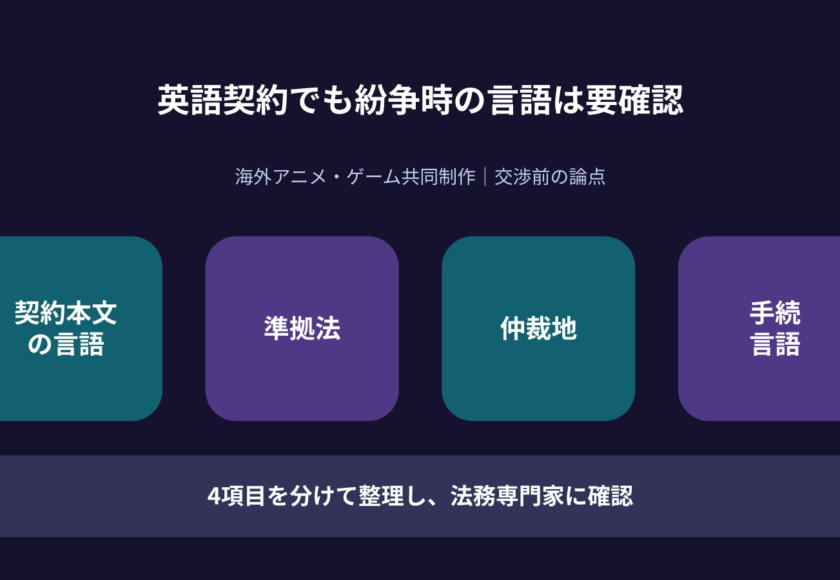
海外パートナーと共同制作を進める際、契約書を英語で作れば紛争時も英語で解決できるとは限りません。「契約書の言語」「準拠法」「仲裁地」「手続言語」はそれぞれ別の検討事項です。アニメ・ゲームの制作担当者が、契約交渉前に専門家へ何を確認すべきかを、JCAA(日本商事仲裁協会)の公開資料と仮想例から整理します。
なお、本記事は法的助言ではありません。個別の契約内容や適用される法律の判断は、弁護士などの専門家にご確認ください。以下では、公開資料に基づく内容と、出典に基づかない一般的な整理を区別して書きます。
仮想例:契約書は英語、準拠法は日本法、手続言語は英語?
【仮想例】日本のゲームスタジオと海外の制作会社が共同開発を検討し、契約書は英語で作成するとします。紛争解決の方法、準拠法、仲裁地、手続言語を自動的に決めたことにはなりません。どの組み合わせが適切かは取引条件や適用法によるため、ここでは特定の組み合わせを推奨しません。交渉前に論点を一覧化し、専門家へ確認するための例です。
1. 決める項目を4つに分けて考える
日本商事仲裁協会(JCAA)の機関誌の連載では、紛争解決条項の主な要素として、準拠法、仲裁機関、仲裁地、言語の4つが挙げられています。これらに優先順位をつけて交渉するという考え方が紹介されており、準拠法と仲裁地は別々に決められるとも説明されています。
実務の入口としては、まず4つの項目を一覧にして、自社にとって譲れない点と、譲ってもよい点を社内で分けておくと、相手方との協議が進めやすくなります。この分け方自体は一般的な整理です。
2. 準拠法:どの国の法律で契約を解釈するか
JCAAのQ&Aには、本案に適用される準拠法は一般に外国法も選択でき、日本法以外が準拠法となったこともあると記載されています。上記の連載には、条項例として、契約は日本法に準拠し解釈されるものとする、という書き方が示されています。
一般的な整理として、準拠法を相手方の国の法律にする場合は、契約書の用語や条項の効果が日本の感覚とずれる可能性があります。その法律の下で条項がどう働くかを、事前に専門家に確認しておくことが大切です。
3. 裁判か、仲裁か
紛争解決の方法として裁判と仲裁のいずれを検討するか、またその条項が具体的にどう機能するかは、契約の対象国や取引条件に左右されます。条項を組み合わせる場合の有効性や執行可能性について、本記事は判断しません。JCAAはモデル仲裁条項と検討ポイントを公開しているため、弁護士と条項案を確認する出発点にできます。
JCAAのページによれば、仲裁を申し立てるには、仲裁で解決することを書面で合意しておく必要があり、基本は契約の段階で予め合意することが勧められています。同ページには、仲裁機関の名称を正確に記載することが重要であること、規則名と仲裁地(例として東京)を明記する形のモデル条項が公開されていることも書かれています。
4. 仲裁地と手続の言語
JCAAのページでは、仲裁地は仲裁手続に適用される国の法律などを決める基準になり、実際には仲裁地の都市で証人尋問などの審問が開かれることが多いとされています。仲裁地は会議を開催する場所と同じ意味とは限りません。JCAAの案内ではオンライン審問も認められる場合があるため、物理的な移動の想定と手続に適用される法を分けて確認します。
手続の言語については、JCAAのQ&Aに、当事者の合意で選べること、審問はテレビ会議などの方法も選べることが記載されています。一般的な整理として、日々のやり取り(メール、仕様書、検収の記録)が使われる言語と、万一のときの手続言語が大きくずれていないかも、合わせて確認しておくとよいでしょう。
5. 契約書本文の言語と、運用のルール
ここからは出典に基づかない、一般的な整理です。契約書を日本語と英語のどちらで作るか、翻訳版を参考訳とするか、それぞれを正本とするか、食い違いがあるときにどちらを優先するかは、事前に決めておきたい項目です。共同制作では、仕様変更や修正範囲の合意がメールやチャットで積み重なることも多く、どの言語で、どの形式で記録を残すかを契約の運用ルールとして書いておくと、後の確認がしやすくなります。
まとめと、ご相談について
準拠法、裁判か仲裁か、仲裁地、手続言語、契約書の言語は、互いに関係し合う項目です。1つずつ個別に決めるのではなく、一覧にして優先順位をつけたうえで、専門家の確認を受けながら相手方と協議することをおすすめします。
FounderBank(ファウンダーバンク株式会社)は、サイトに記載のとおり、企画の整理・設計から共同制作までを段階的に進める支援や、利害関係に縛られない中立的な立場でのチーム構成と進行プランの提案を行っています。ただし、契約書の作成、法的判断、紛争の代理は行いません。共同制作の進め方を整理したい法人のご担当者様は、お問い合わせページからご相談ください。
Before Signing a Co-Production Contract with a Japanese Partner: Five Points on Governing Law, Dispute Resolution, and Language
An English-language co-production contract does not automatically mean that a dispute would be handled in English. Contract language, governing law, arbitration seat and procedural language are distinct decisions. Using JCAA’s public guidance and a hypothetical game co-production, this article helps producers prepare the questions to take to qualified counsel before signing.
This is not legal advice. Please consult a qualified lawyer about your own contract and the laws that apply. Below, statements based on published materials are separated from general suggestions that are not based on a source.
Hypothetical example: English contract, Japanese law, English proceedings?
Suppose a Japanese game studio and an overseas production company negotiate an English-language contract. That alone does not decide the governing law, dispute resolution method, seat of arbitration or procedural language. This example does not recommend any particular combination; the right choice depends on the transaction and applicable law. Use the list as a briefing for legal counsel.
1. Break the decision into four items
A series in the journal of the Japan Commercial Arbitration Association (JCAA) lists four main elements of a dispute resolution clause: governing law, arbitration institution, seat of arbitration, and language. It describes prioritizing these four in negotiation, and explains that the governing law and the seat can be decided separately.
As a general suggestion, list the four items first and decide internally which are essential for your company and which you can flexibly give up.
2. Governing law
The JCAA Q&A states that the governing law for the substance of a dispute can generally be a foreign law, and that cases with a law other than Japanese law have occurred. The series above shows a sample clause stating that the contract is governed by and construed in accordance with Japanese law.
As a general suggestion, if you choose the law of the counterparty's country, terms in the contract may work differently from what you expect. Have a professional confirm how the clauses operate under that law.
3. Court or arbitration
Whether to use court proceedings or arbitration, and how a clause will operate, depends on the countries and transaction involved. This article does not determine the validity or enforceability of a combined clause. The JCAA publishes model arbitration clauses and points for review that can help frame a discussion with counsel.
According to the JCAA, arbitration requires a written agreement to arbitrate, and agreeing in advance at the contract stage is the basic recommendation. The JCAA page also stresses writing the institution's name correctly and publishes a model clause that names the rules and the seat of arbitration (Tokyo as an example).
4. Seat and language of the proceedings
The JCAA page explains that the seat of arbitration determines the national law that applies to the proceedings, and that hearings such as witness examination are often held in the city designated as the seat. The seat of arbitration should not be confused with the physical location of every hearing. The JCAA explains that online hearings may be available, so review procedural law and travel assumptions separately.
On language, the JCAA Q&A states that the parties can choose it by agreement and can also choose to hold hearings by video conference. As a general suggestion, check that the language of your daily records (emails, specifications, acceptance records) is not far from the language of any proceedings.
5. Contract language and operating rules
The rest of this section is a general suggestion that is not based on a source. Decide in advance whether the contract is written in Japanese, English, or both, whether a translation is only a reference or each version is authoritative, and which version prevails if they differ. In co-production, agreements on changes and revisions often accumulate through email or chat, so it helps to state in the contract in which language and format those records are kept.
Summary and inquiries
Governing law, court or arbitration, the seat, the language of proceedings, and the contract language are related to each other. Rather than deciding them one by one, list them, set priorities, and discuss them with the counterparty while receiving professional review.
As described on its website, FounderBank Inc. supports companies step by step from organizing and designing a project through co-production, and proposes team composition and progress plans from a neutral position. We do not draft contracts, give legal judgments, or represent parties in disputes. If you would like to organize how a co-production should proceed, please contact us through the contact page. Note that the form is in Japanese.




この記事へのコメントはありません。