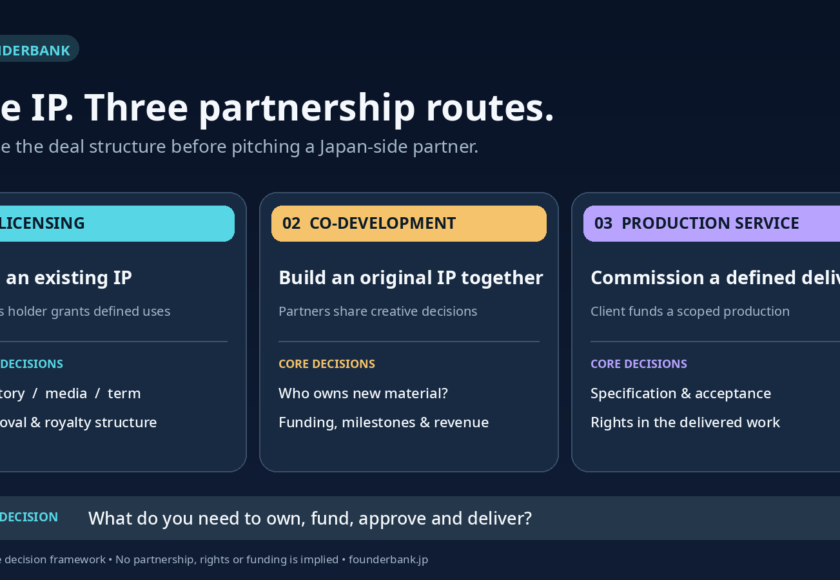
Imagine this fictional situation: a game studio founder has an original character, a playable prototype and a striking 60-second trailer. A Japanese partner is interested—but asks a question the pitch deck cannot answer: “Are you asking to license an existing property, develop a new IP with us, or hire a Japanese production team?” Those three proposals may look similar on a slide. They require different decisions, budgets and approvals.
For overseas studio founders, executive producers and business-development leads exploring Japan, the first useful deliverable is not a longer creative deck. It is a clear choice of partnership structure. This article provides a practical comparison and a brief you can actually send. The scenario is illustrative, not a FounderBank client case or an announced partnership.
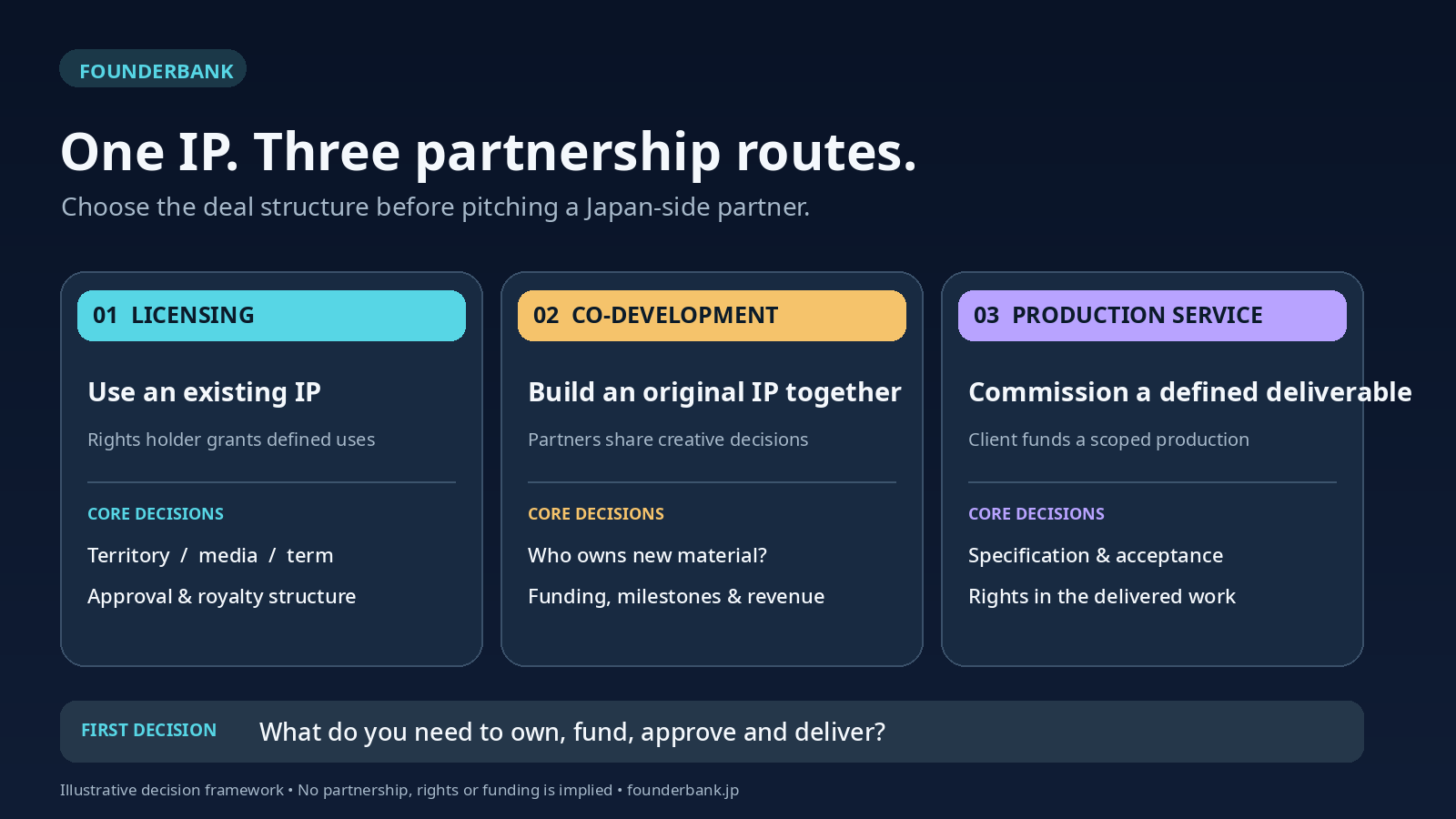
Three routes—and the decision each one solves
| Question | IP licensing | Original-IP co-development | Production service |
|---|---|---|---|
| What are you buying or building? | Permission for defined uses of an existing IP | A new property or format built with partners | Specified creative or technical deliverables |
| Typical decision-maker | IP owner/licensing lead, plus relevant approvers | Studio executives, producers and prospective rights participants | Client producer, production director and procurement lead |
| First critical question | Who controls the required rights and approvals? | Who owns newly created material and who funds each phase? | What is the acceptance standard, schedule and agreed rights treatment? |
| Initial evidence to bring | Proposed usage, territories, media, term and audience | Original concept, prototype, team, development budget and decision rights | Creative brief, asset list, technical specification and milestones |
| What not to assume | Access to one right means access to all uses | Interest means funding, rights or production approval | Paying for work automatically settles all IP questions |
Route 1: Licensing—when the existing world is the reason fans will come
Choose this route when the project depends on a recognizable existing manga, anime, game or character universe. For example, an overseas studio might want to build an interactive fan experience around a Japanese title. The creative pitch is only the opening: the decision also depends on the exact rights required, who can authorize them, the proposed use, and how creative supervision will work.
Prepare a rights-use map before requesting a meeting: target IP; intended medium (game, physical event, merchandise, streamed performance); territories and languages; proposed launch window; promotional assets; any music, performances or recorded voices; and the party responsible for approvals. Different uses may need different permissions. Do not describe access to a rights holder as an executed license.
Budget lines to discuss: any agreed license payment or minimum guarantee, royalty or revenue share, approvals and localization, production and marketing, plus contingency. These are categories—not FounderBank rates or a forecast.
Route 2: Co-development—when both sides are creating the world
Consider this route when the story, characters, game systems or transmedia format are still being developed and the Japanese partner would contribute more than a vendor’s deliverable. The hard questions concern creative authority and business responsibility: who contributes the original material; who may approve character changes; who pays for a prototype; who owns the resulting assets; and who may exploit which rights if the partners separate.
A useful fictional pilot is a short interactive scene with alternate voice performances and a small live audience test. The studio can examine whether the mechanics and story work together before discussing a full series or game. The test does not prove market demand or secure investment; it simply creates a shared object for a go/no-go decision.
Budget lines to discuss: concept and script development, prototype engineering, art and sound, voice casting and direction, translation, producer coordination, user research, legal review, marketing tests and any agreed financing or recoupment mechanism. Keep sponsorship, production investment and distribution advances in separate columns rather than treating them as interchangeable cash.
Co-development governance: five decisions to settle before a full budget
For a fictional cross-border game or animation project, two partners might agree that they both love the same character but disagree on whether a game sequel, live event or merchandise line may be approved. A percentage of ownership alone does not answer that question. Before presenting a joint project as investable or production-ready, prepare a decision-rights sheet:
| Decision | What the first agreement or term sheet should clarify | Who needs to participate |
|---|---|---|
| Background IP versus new IP | Which pre-existing characters, scripts, code and art each party brings; what new material the project creates | Each contributing rights holder and project producer |
| Creative approvals | Who can approve story changes, character use, casting, localization and release milestones | Creative leads and authorized rights decision-makers |
| Derivative uses | Who can propose or authorize a sequel, game adaptation, merchandise, live experience or third-party license | Commercial leads and rights advisers |
| Money and delivery | Who funds each prototype or production milestone, what is delivered, and what happens if a milestone is not funded | Executive producers and finance leads |
| Disagreement or exit | How an unresolved decision is escalated; what may continue if a partner withdraws | Authorized executives and qualified legal advisers |
This is a negotiation-preparation tool, not a statement that joint ownership is automatic or a recommended contract clause. Actual ownership, approval rights and exit mechanisms depend on the parties’ agreements and applicable law. FounderBank can help organize the production and business questions; legal drafting belongs with qualified advisers.
Route 3: Production service—when you know what needs to be made
If the overseas company already owns or controls the required project materials and needs Japanese casting, recording, animation, art, game production or event execution, a defined service engagement may be the clearest starting point. A vendor can quote a deliverable more reliably when the acceptance criteria are concrete.
For Japanese voice production, for example, specify the game platform, number and type of lines, sample script, character direction, recording method, retake rules, delivery file format, schedule, promotion and secondary-use requirements. A silent protagonist or an unvoiced design may not need a casting proposal at all. In that case, the better Japan-side service might be localization review, creator collaboration, market activation or an event concept.
Budget lines to discuss: production labor, talent, studio, direction, localization, project management, revisions, integration testing and any additional usage permissions. Confirm ownership and usage treatment in the actual agreement; do not infer them from the invoice.
Before approaching a Japanese IP holder: what the official application pages actually request
Rights-holder requirements are not interchangeable. For example, KADOKAWA’s official licensing guide asks corporate applicants to identify the target IP or character, product or campaign concept, territory, target schedule, price, estimated volume, distribution channels, company background and prior IP-collaboration experience. KADOKAWA also cautions that some rights are unavailable in certain territories or categories, or are managed by other parties. Its guide requires creative approval before manufacturing, distribution or public announcement.
Kodansha’s official licensing FAQ describes different workflows for merchandising and advertising, including inquiry, project proposal, agreement, advance payment, creative supervision and final checks. It explicitly distinguishes rights in original manga artwork from rights in animation artwork. Its published fee explanation varies by title, product, territory, term and other usage conditions; it does not publish a universal quote or guarantee approval.
| Question for the applicant | What to put in the first brief | Why it matters |
|---|---|---|
| Which version of the work? | Original manga art, anime adaptation, game assets, character names or a combination | Different materials can have different rightsholders and approval routes. |
| Exactly what will fans experience? | One concrete scene, product, interactive mechanic or promotional use | The requested permission must match the proposed use. |
| Where, when and how? | Territory, language, channel, schedule, estimated quantities and distribution plan | The licensor can assess the scope and feasibility of the proposal. |
| Who can deliver and pay? | Applicant company, relevant track record, production team and preliminary budget categories | The application needs an identifiable accountable business and credible execution plan. |
| What remains unapproved? | Unresolved rights, creative review, announcement timing and third-party music or performances | Exploratory interest is not a license, a confirmed performer or permission to announce. |
This is a planning comparison drawn from the two publishers’ public guidance, not a universal application form. If the project instead concerns an entirely new original IP, clarify proposed ownership, creative decision rights, production funding and approval responsibilities before choosing co-development. A production-services engagement may be more appropriate if the studio already controls the material and only needs defined deliverables.
A fourth practical track: Japanese voice casting and game audio
Some studios do not need an IP license or a co-development agreement at all. They own an original game and need Japanese performances, recording direction and integration-ready audio. Treat this as a distinct voice-production workstream within a scoped service engagement—not as a promise of access to any particular performer.
| Producer’s decision | Minimum information to provide | Who should decide |
|---|---|---|
| Does the design actually need voice? | Playable sample, dialogue density, target player experience and a small representative script | Game director and narrative lead |
| What should be tested first? | Character range, emotional lines, battle cues, pronunciation and engine delivery format | Audio director and localization lead |
| What is the proposed engagement? | Languages, line count, sessions, retake scope, territory, duration, marketing uses and approvals | Executive producer, rights/legal lead and talent representatives |
| Which costs require separate quotes? | Performers, casting, studio, direction, translation, editing, pickups, file delivery and additional uses | Producer and procurement/finance lead |
For an early-stage title, a defined paid sample can help test performance and the production pipeline before a full recording order. The sample’s scope, fees and usage must be agreed in advance. See our game-voice pilot design and full-voice versus selective-audio decision guide for illustrative approaches.
Copy-ready partnership brief: four choices, one next decision
Use this template as a first-contact brief, not as a binding rights or funding offer. Remove confidential information until an appropriate disclosure arrangement is in place.
Studio / country / website:
Contact name and decision-making role:
Project title / format / target platform:
One-sentence player or fan experience:
Current stage and next milestone:
Primary request (select one):
[ ] Existing Japanese IP license
[ ] New original-IP co-development
[ ] Defined production services
[ ] Japanese voice casting and audio
IP ownership and permissions already secured:
Japan-side partner roles requested:
Territories, languages and intended uses:
Indicative total budget and confirmed funding:
Japan-side budget categories and payer:
Approvals or rights still unresolved:
One decision needed from the first meeting:
Proposed next meeting / target date:
For licensing inquiries, attach the information requested by the relevant rights holder’s own application process. For co-development, specify which new assets and decisions would be shared. For production services and voice work, specify acceptance criteria and usage. These routes can coexist, but each requires its own accountable owner and commercial terms.
A one-page decision brief for your first Japan-side meeting
Copy the following into a document. If several fields remain unknown, the next meeting should resolve those questions rather than negotiate a headline fee.
| Field | What to write |
|---|---|
| Decision owner | Name the executive producer or business lead who can approve the next step. |
| Desired route | Licensing / co-development / production service / undecided—and why. |
| Fan experience | Describe one scene the audience or player will actually encounter. |
| Rights status | Original material, third-party elements, known permissions and unresolved approvals. |
| Requested Japan-side role | Rights liaison, producer, co-developer, casting/recording, localization, event execution or other. |
| Project phase | Concept, prototype, financing, pre-production, production or launch. |
| Cost responsibility | Who would pay for development, talent, approvals, marketing and contingency? |
| Next decision | Exactly what can be decided in the first 20-minute call, and by whom? |
A practical four-stage path to a real partner decision
- Qualification: confirm the project’s actual need and whether the required Japanese expertise or rights are relevant.
- Scope and evidence: exchange a non-confidential one-page brief, prototype links where permitted, and the unresolved rights/funding questions.
- Partner design: identify the prospective decision-makers, production roles, approval path and cost-bearing parties. Do not announce the collaboration yet.
- Small commitment: agree a defined feasibility study, paid pilot or structured next meeting, subject to each party’s approvals and terms.
Many introductory calls fail because they jump from “we love the concept” to “let’s collaborate” without defining the decision. A useful call ends with one named owner, one document to exchange and one next decision date—not a vague promise of future funding.
What FounderBank can discuss
FounderBank works across Japanese entertainment production and business development, including voice talent, original IP concepts, game/anime-related creative work and fan experiences. The appropriate role—producer, coordination partner or specialist sourcing—must be established for each project. No third-party IP access, funding, license or performer availability is guaranteed by this article.
If you are an overseas studio founder or producer, send a non-confidential version of the one-page brief above and tell us which of the four tracks you are exploring. Contact FounderBank to discuss a 20-minute introductory call. You can also start from our English-language introduction or review our existing one-page collaboration brief. This article is a business-planning framework, not legal or investment advice; specific rights and contracts require qualified review.

この記事へのコメントはありません。