Illustrative scenario, not a reported client case: A game studio founder arrives at a Japan-side meeting with a 90-second fantasy-game trailer. The Japanese producer likes the world. But the conversation stalls: should they record Japanese voices, build a playable chapter, or invite fans to test the story? Each answer implies a different team, budget and permission set.
The next step is not to announce a co-production. It is to agree on one decision the first prototype must make possible. This guide gives international game and animation studios three practical routes, a comparison table and a copy-ready brief for a first discussion.
1. Start with the uncertainty, not the production format
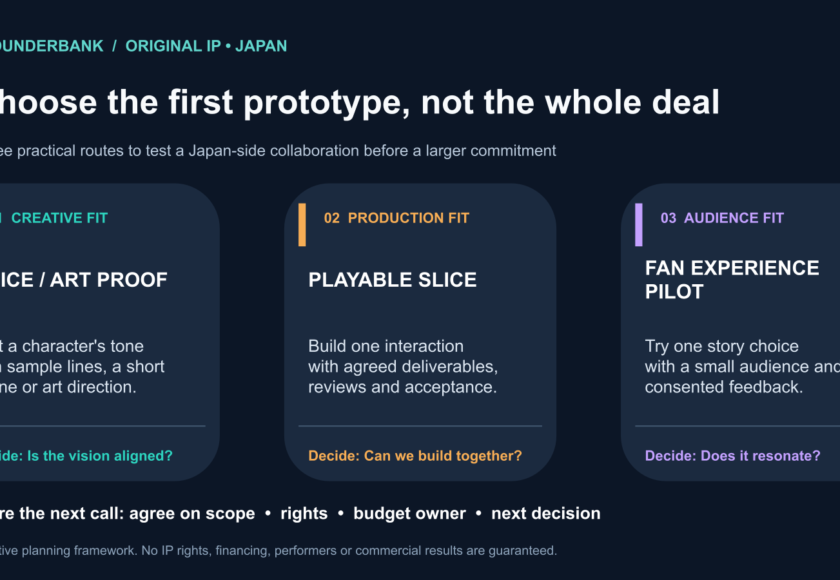
“We want to work with Japan” can mean at least three different unresolved questions. Creative fit: can the Japanese art, writing or voice team express the intended world? Production fit: can both sides deliver a working interaction against shared specifications? Audience fit: will a particular story or play mechanic make sense to the people it is designed for?
Do not commission all three tests automatically. Choose the smallest test that could change a real go/no-go decision. A studio that has not finalized the game’s narrative may need a creative proof before paying for a larger recording session. A studio with approved characters but uncertain interaction design may need a playable slice instead.
2. Compare the three prototype routes
| Route | What to test | Minimum deliverable (example) | Primary owner | Decision at review |
|---|---|---|---|---|
| A. Voice / art proof | Character tone, visual direction, localization nuance | One short scene, sample dialogue or character art treatment | Creative lead + Japan-side art/audio producer | Does the interpretation match the creative brief? |
| B. Playable slice | Implementation quality and production collaboration | One functional interaction with acceptance criteria | Game producer + engineering/art leads | Can both teams deliver to the agreed specification? |
| C. Fan experience pilot | Comprehension, participation and narrative appeal | One limited story choice tested with an appropriately consented audience | Experience producer + event/testing lead | What feedback changes the next creative decision? |
These are planning examples, not standard packages or fixed industry prices. A voice proof can include professional performers only after their terms and intended uses are agreed. A fan pilot does not itself grant permission to use an existing anime or game IP.
3. Three fictional ways the same concept could proceed
Route A: The hero’s voice is still undefined
A fictional overseas RPG team has a silent exploration protagonist and one pivotal dialogue scene. Instead of commissioning a full voice cast, the team first prepares a character sheet, an approved script excerpt, language requirements and the intended uses of any sample recording. The review asks whether the scene needs performed dialogue at all. If it does, the next step is a properly scoped audio brief. See our four-scene Japanese game-audio decision guide.
Route B: The art is compelling, but the game loop is unproven
A fictional indie studio proposes a cooperative puzzle game with anime-style characters. The initial collaboration produces one short, playable loop rather than a trailer. Before work begins, the parties define who supplies source files, how a milestone is accepted, which revisions are included and what may be shown publicly. The review focuses on whether the working relationship can support the next production milestone.
Route C: The IP world is clear, but the fan interaction is not
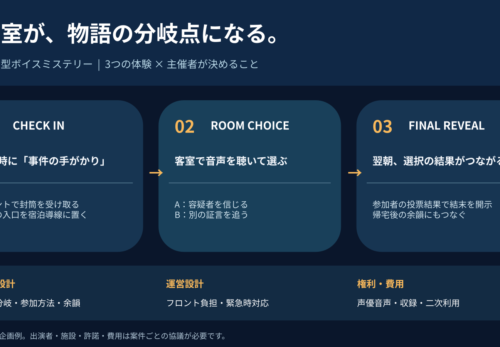
A fictional original-IP creator wants to know whether fans enjoy choosing a character’s moral dilemma. A small, permissioned experience can test a single branching choice, with an accessible alternative for people who do not wish to participate. The organizer documents how feedback is collected, what participants consent to, and who may reuse event footage or responses. The goal is learning, not claiming that a fan event proves commercial demand.
4. What the first budget must actually cover
| Cost or resource | Questions to settle before quotation |
|---|---|
| Creative and technical production | Script, illustration, localization, engineering, sound, deliverable format and revision rounds |
| Voice or performer work (if needed) | Role, session scope, recording direction, retakes, territory, media and secondary use |
| Fan test or live activation (if selected) | Venue, ticketing, accessibility, staffing, insurance, consent, feedback handling and cancellation terms |
| Coordination and approvals | Decision owners, Japanese-language liaison, existing-IP permission, review checkpoints and documentation |
| Next-stage option | Who pays for a larger build, which deliverables can be reused and whether a new agreement is required |
No price, free accommodation, sponsorship, talent availability or financing is assumed. The budget owner and rights holder must be identified for the particular project; a prototype agreement should not be presented as a license, co-ownership agreement or investment commitment.
5. Copy-ready first-prototype brief
Use this template in an initial email or introductory meeting. Estimates and “not decided” answers are acceptable.
JAPAN-SIDE FIRST PROTOTYPE BRIEF
Studio / company:
Project / genre / platform:
What decision must the prototype unlock?
[ ] Creative fit  [ ] Production fit  [ ] Audience fit
Proposed deliverable and what is OUT of scope:
Existing materials, IP rights and approvals already secured:
Japan-side roles requested:
Budget owner / available budget range:
Review owner / acceptance criteria:
Target decision milestone (not a promised delivery date):
Contact / preferred next step:
A useful first meeting ends with a named decision owner, a concrete artifact, the permission questions still open and a date to review the proposed scope. It need not end with a promise of licensing or funding.
6. How FounderBank can help
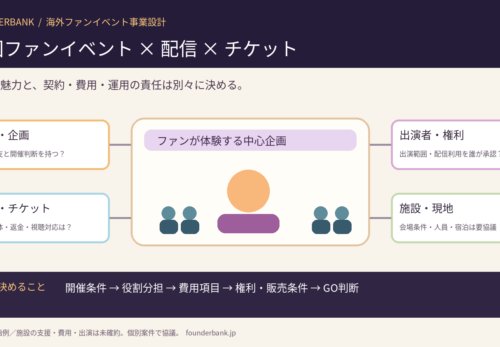
FounderBank works on entertainment planning, Japanese voice-actor casting and cross-border creative coordination. For an overseas studio, the initial conversation can help separate an existing-IP licensing request, an original-IP co-development proposal and a defined production commission. These are different commercial paths; our broader Japanese IP partnership decision guide compares them.
For overseas studios: Send a short project overview and the completed brief through our contact page. Ask for an exploratory 20-minute discussion about which Japan-side pilot is appropriate. Any engagement, performer booking, rights clearance and commercial terms remain subject to separate agreement.
日本のクリエイター・主催者の方へ: 海外スタジオとの共同開発をいきなり大型契約にせず、「何を検証する試作か」「誰が判断するか」「権利と予算の前提」を整理するための企画相談を受け付けています。お問い合わせはこちら。
Frequently asked questions
Does a prototype secure rights to a famous Japanese IP?
No. The rights holder must evaluate and approve any proposed use separately. An original concept can be discussed without implying that existing third-party IP has been licensed.
Should we hire a well-known Japanese voice actor for the pilot?
Not automatically. First determine whether the test genuinely needs a performance, what material will be recorded and where it may be used. Casting and reuse conditions require individual negotiation.
Is a successful pilot proof that a larger production will be funded?
No. A pilot can inform a creative or operational decision, but it does not establish financing, distribution, ownership or future commercial results.


この記事へのコメントはありません。